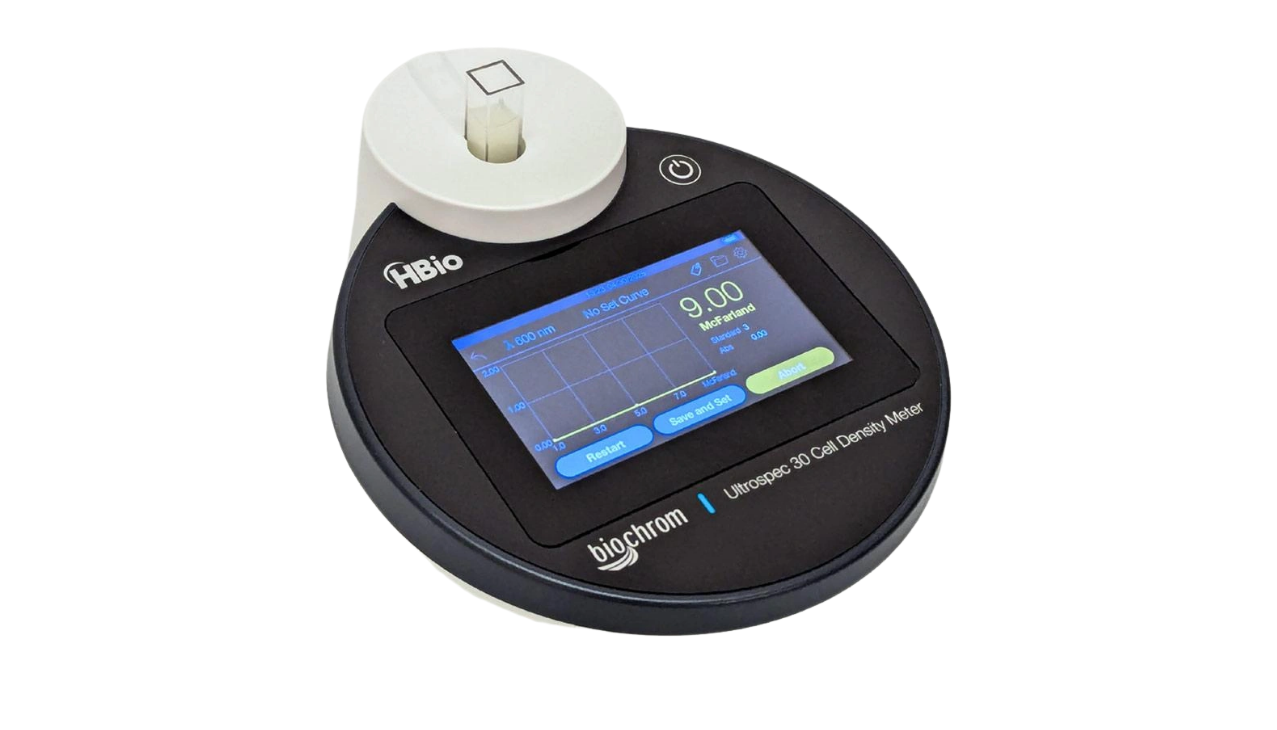
Why Standard Curves Matter in Microbial Growth Measurement
In microbiology, estimating how many cells are in a culture is fundamental — whether you're engineering E. coli for protein production, tracking yeast in a bioprocess, or simply checking how fast bacteria are growing. Many labs lean on optical density (OD) measurements, particularly at 600 nm (“OD600”), as a convenient shortcut. But without calibration, that shortcut can come unstuck.
Here’s why standard curves are not just a useful add-on, but an essential tool — and what to think about if you’re buying or using devices like spectrophotometers, cell-density meters, or turbidimeters.
The Problem with Raw OD600 Readings
When you take an OD600 reading, you’re not measuring how many viable cells are in a sample — you’re measuring how much light is scattered. Several factors muddy the waters:
- Cell morphology: Bigger cells, or cells with non-standard shapes, scatter light differently.
- Clumping: If bacteria stick together, they scatter more or less than freely suspended single cells.
- Instrument geometry: Different machines, different cuvettes or test tubes, and even the path-length of the light all change how much scattering is detected.
- Settling: Cells may settle during measurement if left standing — that can skew the reading.
So, two cultures with very different cell counts might give surprisingly similar OD600 values — or vice versa.
What a Standard Curve Actually Does
A standard curve (sometimes called a calibration curve) links your OD600 readings to a more meaningful metric — typically viable cell count (e.g., colony-forming units per millilitre, CFU/mL) or biomass. By measuring a set of known dilutions, you build a map that tells you: “when my OD600 is this, I roughly have that many cells.”
That’s powerful, because it allows you to:
- Pinpoint the exponential (log) phase accurately — crucial when you want to induce protein expression or sample at a particular growth point.
- Adjust for changes — if you swap media, change strains or move to a different measuring device, you can regenerate the curve so your data stays consistent.
- Correct for device differences — by calibrating each instrument, you reduce inter-machine variability.
- Improve reproducibility — standard curves support more consistent and comparable results across experiments or collaborators.
How to Generate a Reliable Standard Curve
Building a standard curve is not rocket science, but it’s not something you want to rush either. Here’s a practical workflow:
- Prepare a culture that’s representative of your experiments.
- Serially dilute the culture (for example, 10-fold dilutions), so you cover a broad range of cell densities.
- For each dilution:
- Measure OD600 in your instrument.
- Plate a known volume for CFU counting (or use another validated method of viable cell quantification).
- Plot CFU/mL (or equivalent) against the OD600 values. Fit a trend line (often linear in a sensible range).
- Repeat if you change any key variable (strain, media, instrument, vessel type). Standard curves are context-specific.
- Store or document your standard curve in your system or lab notebook, so you can refer back to it reliably.
Some sources emphasise using flat-faced cuvettes (rather than round tubes) to reduce refraction artefacts, and ensuring samples are well mixed before reading to avoid settling effects.
Also, McFarland standards can serve as a rough visual/turbidity reference, but they don’t substitute for a properly constructed CFU-based standard curve.
Why Your Choice of Equipment Matters
If you're in the market for instruments to measure microbial growth, keep in mind:
- Software features: Does the device let you save standard curves? Can you apply them later to convert OD to cell counts?
- Optical design: Understand the light path, the cuvette or vessel format your instrument supports, and how reproducible measurements are.
- Data export: The ability to export readings + standard curve parameters allows for deeper analysis later (spreadsheets, graphing, reporting).
- Support and documentation: Good suppliers will guide you in how to build and maintain standard curves, which is more important than you might think.
Common Pitfalls & How to Avoid Them
- Overlooking non-linearity: At high cell densities, OD doesn’t scale linearly with cell count. If your readings go beyond the “safe” linear zone, dilute first.
- Not regenerating curves: A standard curve made for one strain or medium doesn’t always apply if you change experimental conditions.
- Ignoring instrument bias: Different devices read differently — build a standard curve on each instrument you rely on.
- Settling artefacts: Mix before measuring. Letting cells settle will give you underestimates.
- Relying solely on turbidity standards: McFarland or visual turbidity standards are helpful, but they don’t replace the precision of CFU-based calibration.
Why This Matters for Your Lab or Industrial Process
- For research labs, standard curves mean more accurate growth-phase determination and more reliable repeatability — essential for reproducible science.
- In bioprocessing or industrial fermentation, they help you optimise harvest points, improve yield consistency, and ensure scale-up fidelity.
- For quality control, standard curves support validation of instruments and methods — which can be critical for regulated environments.
Final Reflections
Skipping the step of building a standard curve may feel like a time-saving shortcut, but in reality, it trades reliability for convenience. By calibrating OD600 to real biological measures like CFU, you transform rough estimates into data you can trust.
Whether you’re running experiments in academic research, process development in biotech, or quality assurance in manufacturing, investing time in standard curve generation is a small effort with big returns — greater precision, reproducibility, and confidence in your microbial measurements.
