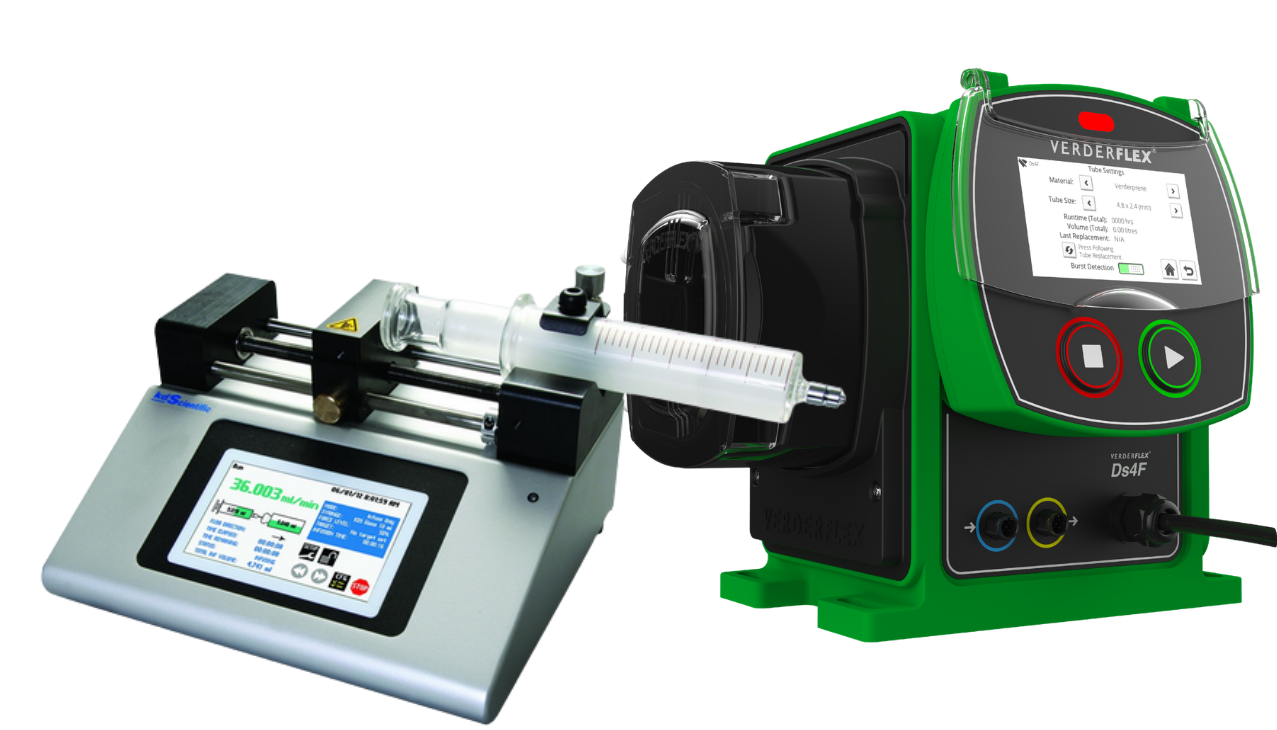
Peristaltic vs Syringe Pumps: Choosing the Right Fluid Handling Solution for Your Lab
In any modern laboratory — whether you’re working in biopharma, analytical chemistry, microfluidics or academic research — fluid handling accuracy is essential for reproducible results and operational safety. Two of the most widely used options for precise liquid transfer are peristaltic pumps and syringe pumps. Each has distinct advantages and limitations, and understanding the differences can help you select the optimal pump for your application.
Why Pump Selection Matters in the Lab
Fluid delivery systems are critical across a range of laboratory workflows, from dosing reagents and media to delivering biological samples or carrying out controlled infusions. Choosing the wrong pump can impact experiment outcomes, lead to contamination, or increase maintenance time — all of which affect productivity and data quality.
How Peristaltic Pumps Work
Peristaltic pumps transport liquids by compressing and relaxing flexible tubing with a series of rollers or shoes. This action creates a vacuum that draws fluid forward in a controlled manner. Because the liquid only contacts the internal tubing, there is minimal risk of cross‑contamination — a major advantage for sterile environments or sensitive biological samples.
Key Benefits
- Low contamination risk: Fluid is isolated within the tubing.
- Suitable for viscous and particle‑laden liquids: Handles thicker or shear‑sensitive fluids without issue.
- Simple maintenance: Only the tubing needs to be replaced periodically.
- Continuous flow: Excellent for prolonged or high‑volume transfers.
Laboratory Use Cases
Peristaltic pumps are ideal for tasks such as buffer and media transfer, gentle pumping of cell cultures, and processing corrosive or abrasive fluids where contact with mechanical parts must be avoided.
However, because the flow can be slightly pulsatile due to the rolling action, peristaltic systems may not be the best fit for processes needing ultra‑smooth or droplet‑free flow at very low volumes.
Understanding Syringe Pumps
Syringe pumps operate by advancing a plunger within a syringe barrel at a controlled rate. This design lets them deliver very precise volumes of liquid, making them invaluable for microdispensing and analytical applications.
Benefits for Laboratory Work
- High precision: Excellent for delivering controlled, low‑volume fluid doses.
- Minimal pulsation: Smooth liquid delivery supports sensitive analytical workflows.
- Programmable control: Many modern syringe pumps integrate with software for automated dosing schedules and repeatable results.
Ideal Applications
Syringe pumps are often used in HPLC systems, microfluidic experiments, titration procedures, controlled reagent addition and other precision‑dependent laboratory tasks where accurate volumes are non‑negotiable.
Keep in mind that syringe pumps deliver finite volumes based on syringe size, so they may require refill or multi‑syringe setups for prolonged operations.

This comparison highlights how each pump excels in different areas — peristaltic pumps for continuous, contamination‑free fluid transfer, and syringe pumps for precise dose control in more analytical or microfluidic environments.
Selecting the Best Pump for Your Laboratory
When deciding between a peristaltic and syringe pump, laboratory professionals should consider:
- Flow requirements: Do you need continuous, longer‑duration fluid transfer or precise micro‑dosing?
- Fluid characteristics: Is your target fluid viscous, particulate‑laden or chemically aggressive?
- Contamination concerns: Would direct liquid contact with pump mechanisms lead to contamination risk?
- Throughput and experiment duration: Will the system run for minutes, hours or days?
Matching pump performance to these criteria ensures smoother workflows, better data quality and reduced downtime.
Conclusion
Both peristaltic and syringe pumps play vital roles in modern laboratory environments. Peristaltic pumps are ideal for continuous, contamination‑free fluid handling — particularly with viscous or sensitive liquids. Syringe pumps are indispensable in applications where precision and reproducibility at small volumes are mission‑critical. By understanding the strengths of each technology, lab professionals can make an informed choice that supports their experimental goals and enhances operational efficiency.
