Lithium Battery Storage: Why Safety Cabinets Are Essential in the Laboratory
Lithium-ion batteries have become an essential part of modern laboratories and research facilities. From portable laboratory instruments and laptops to handheld equipment, robotics and specialist medical devices, lithium batteries provide a convenient and powerful source of portable energy. However, while lithium-ion batteries are generally safe when correctly manufactured, used and maintained, they can present a significant fire risk if they are damaged, incorrectly charged or stored in unsuitable conditions.
For laboratories handling multiple lithium batteries, having appropriate lithium battery storage procedures and dedicated lithium battery safety cabinets can play an important role in reducing the risk to staff, equipment and facilities.
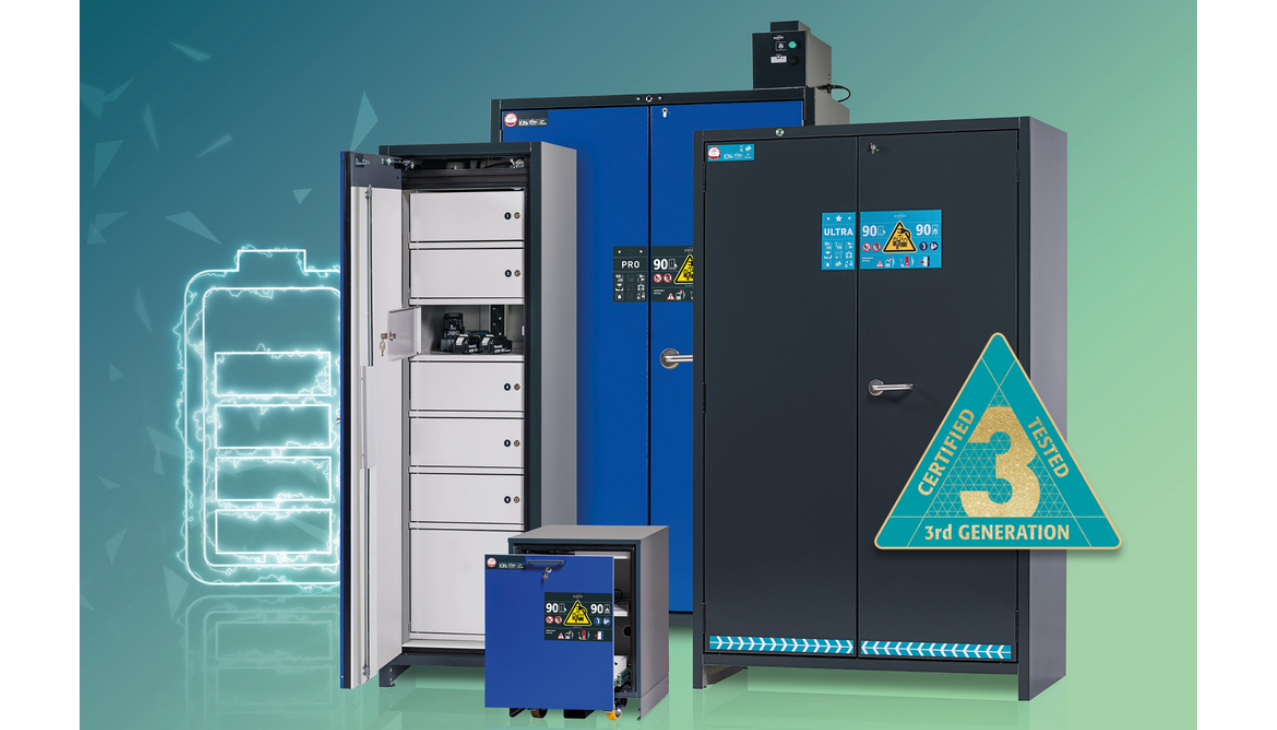
The Asecos ION-LINE range has been specifically developed for the safe storage and charging of lithium-ion batteries, providing laboratories and other professional environments with a dedicated solution for managing this growing safety challenge.
Why do lithium-ion batteries present a fire risk?
Lithium-ion batteries store a considerable amount of energy in a relatively compact package. This high energy density is one of the reasons they are so useful, but it also means that a battery fault can have serious consequences.
A lithium-ion battery can enter a condition known as thermal runaway if its internal temperature increases uncontrollably. This can occur following physical damage, manufacturing defects, electrical faults, overcharging or exposure to excessive heat.
During thermal runaway, the battery can rapidly increase in temperature and release flammable gases. This can result in fire, rapid flame development and, in some circumstances, explosion. Lithium-ion battery fires can also produce hazardous and toxic gases.
UK fire services highlight several warning signs that a lithium-ion battery may be failing, including unusual heat, swelling or bulging, leaking, unusual smells, hissing or cracking sounds and changes in charging performance.
This means that lithium battery safety needs to be considered throughout the battery's lifecycle – from purchasing and transportation through to charging, storage, inspection and disposal.
Correct lithium battery storage in the laboratory
Good battery management starts with having clear procedures for where and how batteries are stored. Simply placing batteries on a laboratory shelf or in a general-purpose cupboard may not provide an appropriate level of protection, particularly where larger quantities or higher-capacity batteries are involved.
Laboratories should consider:
- Storing lithium-ion batteries in a dedicated, fire-resistant safety cabinet where appropriate.
- Keeping batteries away from sources of heat, ignition and combustible materials.
- Protecting batteries from physical damage, impact, crushing and puncturing.
- Regularly inspecting batteries for signs of damage, swelling, leakage or overheating.
- Separating damaged or suspect batteries from those that are suitable for continued use, following an appropriate risk assessment and manufacturer guidance.
- Following the battery manufacturer's instructions for storage, handling and charging.
- Keeping storage and charging areas away from escape routes and other areas where a battery fire could prevent people from leaving safely.
- Ensuring staff understand the correct procedures for handling, charging and storing lithium-ion batteries.
UK Government guidance similarly recommends following manufacturer instructions, using the correct charger, avoiding extreme temperatures and ensuring lithium batteries are not charged close to combustible materials or where they could obstruct escape.
Why is a lithium battery safety cabinet important?
A dedicated lithium battery storage cabinet provides a controlled and fire-resistant environment for storing batteries and can help to contain the consequences of a battery fire.
This is particularly important in laboratories because a battery incident does not only have the potential to injure personnel. Fire, smoke and hazardous gases could damage expensive laboratory equipment, compromise experiments and samples, contaminate laboratory areas and result in significant operational disruption.
A purpose-designed safety cabinet can therefore form an important part of a laboratory's wider fire risk assessment and battery safety strategy.
The Asecos ION-LINE range is specifically designed for the safe storage of lithium-ion batteries. The range includes safety storage cabinets designed around the particular risks associated with lithium-ion batteries, rather than treating them in the same way as conventional laboratory storage requirements. Asecos documentation identifies the ION-LINE range as safety storage cabinets for lithium-ion batteries, tested in accordance with relevant fire-resistance standards.
Safe lithium battery charging
Charging is an important part of lithium battery safety because a battery can be subjected to additional thermal and electrical stresses during the charging process.
Where lithium batteries are routinely charged within a laboratory, organisations should establish a designated charging area and ensure that appropriate procedures are followed.
Good practice includes:
- Using the charger specified or approved by the battery manufacturer.
- Inspecting batteries and chargers before use.
- Never charging batteries that are visibly damaged, swollen or otherwise suspected to be faulty.
- Avoiding unattended charging wherever the risk assessment or manufacturer's instructions require supervision.
- Preventing chargers and batteries from becoming covered or overheated.
- Keeping charging areas away from combustible materials and escape routes.
- Allowing batteries that have become hot during use to cool before charging, where recommended by the manufacturer.
- Providing appropriate fire detection and emergency procedures.
- Considering a battery charging cabinet where batteries are routinely charged and stored within the same area.
The use of a dedicated cabinet can help laboratories establish a clearly defined location for battery storage and charging, making it easier to control access, inspect batteries and implement consistent safety procedures.
The Asecos ION-LINE range
The Asecos ION-LINE safety cabinets are designed specifically for the storage and charging of lithium-ion batteries. They provide laboratories, research facilities and other professional environments with a dedicated solution for managing lithium battery fire risks.
Depending on the model and configuration, the range can provide features designed around both storage and charging requirements. The latest ION-LINE developments also include solutions intended specifically for storage without integrated charging sockets, providing greater flexibility where batteries do not need to be charged inside the cabinet.
When selecting a lithium battery safety cabinet, laboratories should consider factors including:
- The number and size of batteries being stored.
- Battery capacity and type.
- Whether batteries will also be charged inside the cabinet.
- The location of the cabinet within the laboratory or building.
- Required fire resistance and relevant certification.
- Ventilation and electrical requirements.
- Detection and alarm options.
- The laboratory's fire risk assessment and emergency procedures.
Choosing the correct cabinet should always be based on the specific application and a suitable risk assessment rather than simply the amount of available storage space.
Lithium battery safety in NHS and healthcare environments
Lithium battery safety is not limited to research laboratories. Healthcare organisations are also increasingly reliant on lithium-powered equipment.
Lithium batteries can be found in a wide variety of healthcare applications, including medical equipment, mobility aids, portable devices and cleaning robots. With batteries becoming increasingly common throughout hospitals, care homes and other healthcare environments, effective storage and charging procedures are becoming an important part of wider fire and health and safety management.
In July 2026, Asecos published a new Lithium Battery Safety Guide for Healthcare, highlighting the particular challenges faced by healthcare organisations. The guidance focuses on risk, containment and operating procedures, with the aim of helping organisations protect patients, staff and critical services.
This is particularly important within the NHS, where even a relatively small battery fire could have consequences beyond the immediate incident. Smoke, fire or evacuation could disrupt patient care, restrict access to clinical areas and affect essential services.
One of the key risks identified by Asecos is the charging of small devices that are subsequently left unattended. Healthcare organisations therefore need to consider not only where batteries are stored, but also where and how they are charged.
For hospitals and other healthcare facilities, dedicated lithium battery storage cabinets can form part of a broader strategy for controlling these risks, alongside appropriate staff training, inspection procedures, charging protocols, fire detection and emergency planning.
Protecting people, equipment and laboratory operations
Lithium-ion batteries offer enormous benefits to modern laboratories and healthcare organisations, but their growing use means that battery safety should not be overlooked.
The risk associated with lithium batteries can be reduced through a combination of safe storage, controlled charging, regular inspection, staff training and appropriate emergency procedures. For laboratories storing significant numbers of batteries, a purpose-designed lithium battery safety cabinet can provide an additional layer of protection and help to contain the consequences of a battery-related incident.
The Asecos ION-LINE range provides a dedicated solution for organisations looking to improve their lithium battery storage and charging safety, helping laboratories and healthcare facilities take a proactive approach to this increasingly important area of fire safety.
By considering lithium battery storage as part of the laboratory's wider fire risk assessment, organisations can help protect their people, facilities, valuable equipment and vital research from an avoidable battery-related incident.
Key lithium battery safety considerations
Store safely: Use appropriate, dedicated storage for lithium-ion batteries where required by your risk assessment.
Charge correctly: Follow manufacturer instructions and use the correct charger in a designated charging area.
Inspect regularly: Look for swelling, damage, unusual heat, leakage, odours or changes in charging performance.
Separate damaged batteries: Do not continue using batteries that show signs of damage or failure.
Plan for emergencies: Ensure staff know what to do in the event of overheating, smoke or fire and that appropriate emergency procedures are in place.
Consider specialist storage: A purpose-designed lithium battery safety cabinet can provide an additional level of fire protection and containment.
Important: Lithium battery storage and charging requirements will vary according to the battery type, capacity, quantity, application and environment. Always follow the battery manufacturer's instructions and complete an appropriate site-specific risk assessment before establishing storage or charging arrangements.
You can see our full range of battery storage cabinets HERE.
