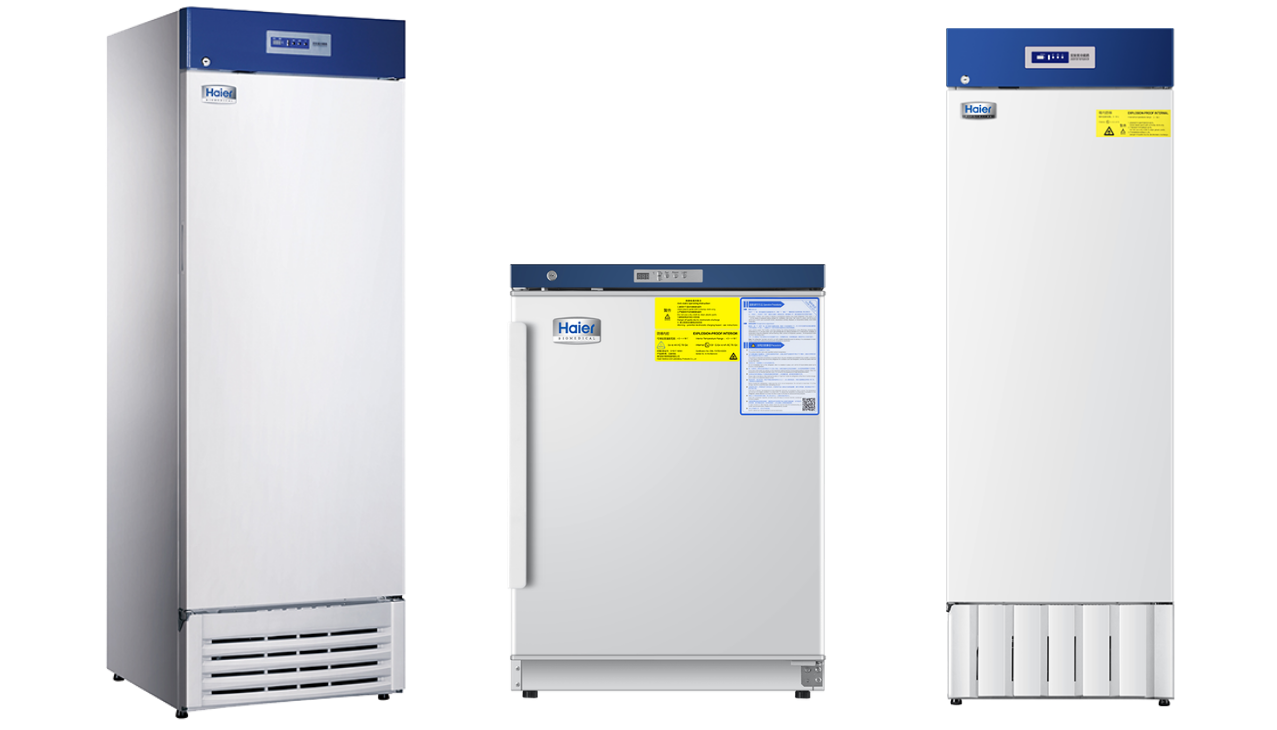
Biomedical Refrigeration: The Smarter, More Sustainable Choice for Modern Laboratories
When laboratory professionals evaluate refrigeration solutions, the conversation often starts—and ends—with energy consumption. “What’s the lowest kWh?” is a common question. But when it comes to laboratory sustainability, that’s only part of the picture.
For users of Haier Biomedical refrigeration—or those considering an upgrade—true sustainability goes far beyond energy labels. It’s about balancing energy efficiency, performance reliability, product protection, and long-term durability.
Let’s explore why the Haier Biomedical refrigeration range represents a smarter, more sustainable investment for laboratories.
Why “Lowest Energy” Doesn’t Always Mean Most Sustainable
At first glance, a unit with the lowest daily energy consumption seems like the obvious eco-friendly choice. But many of these systems achieve low kWh figures by stripping back critical components—most notably active airflow systems (fans).
This creates a hidden risk.
Static refrigeration systems (without fans) rely on natural air circulation, leading to temperature stratification:
- Colder zones at the bottom (as low as 2°C)
- Warmer zones at the top (up to 10°C)
For laboratories storing sensitive samples, reagents, or pharmaceuticals, this inconsistency can lead to undetected product degradation—a far greater environmental and financial cost than a slightly higher energy bill.
Energy Efficiency in Context: Finding the “Sweet Spot”
Let’s compare typical lab refrigeration options:
- Static, ultra-low energy units: ~0.33 kWh/24h
- ✔ Low energy use
- ✖ High risk of temperature instability
- Modern fan-assisted systems (e.g. Haier HLR-118SF): ~0.56 kWh/24h
- ✔ Balanced energy efficiency
- ✔ Consistent temperature control
- ✔ Reduced product risk
- Older or basic systems: 0.9–1.1 kWh/24h
- ✖ Higher energy consumption
- ✖ Limited performance benefits
The Haier Biomedical HLR-118SF sits firmly in the “sustainability sweet spot”—delivering low energy consumption without compromising performance or safety.
The Four Pillars of Sustainable Laboratory Refrigeration
1. Energy Efficiency (The Baseline)
Sustainable refrigeration starts with efficient design.
The Haier Biomedical range uses hydrocarbon refrigerants (R600a)—a greener alternative with:
- Lower global warming potential (GWP)
- Reduced energy consumption
- Improved thermodynamic efficiency
Unlike static systems, Haier combines this with fan-assisted cooling, ensuring energy savings don’t come at the expense of performance.
2. Temperature Stability (The Risk Mitigator)
Temperature uniformity is critical in any laboratory environment.
Static systems:
- Suffer from uneven cooling
- Have slow recovery after door openings
- Increase risk of sample degradation
Haier Biomedical refrigerators:
- Use active airflow systems
- Maintain consistent internal temperatures
- Offer rapid recovery times
This ensures sample integrity, even in high-use environments.
3. Product Waste Reduction (The Hidden Carbon Cost)
One of the most overlooked aspects of sustainability is product loss.
When a refrigerator fails to maintain stable conditions:
- Samples degrade
- Reagents must be replaced
- Energy, water, and raw materials used in production are wasted
This creates a significant hidden carbon footprint.
By protecting contents effectively, Haier Biomedical refrigeration systems:
- Reduce waste
- Lower indirect environmental impact
- Improve laboratory efficiency
Key takeaway:
A fridge that prevents product loss is inherently more sustainable than one that simply uses less energy.
4. Durability & Lifecycle (The Long-Term Impact)
Sustainability isn’t just about daily operation—it’s about how long a product lasts.
A refrigerator with a 10-year lifespan is far more sustainable than one that needs replacing after five.
Haier Biomedical units are designed with:
- Robust compressors
- High-quality shelving and hinges
- Reliable construction for demanding lab environments
This reduces:
- Electronic waste
- Manufacturing demand
- Total cost of ownership
Haier Biomedical: A Balanced Approach to Sustainability
The key message for laboratory buyers is simple:
True sustainability is a balance—not a single metric.
If your only priority is achieving the lowest possible kWh, a static refrigerator may appear attractive. However, this often comes with:
- Increased risk of temperature fluctuations
- Higher likelihood of product loss
- Shorter equipment lifespan
By contrast, the Haier Biomedical refrigeration range delivers:
- Competitive energy efficiency
- Superior temperature control
- Enhanced product protection
- Long-term reliability
The Real Question: What Does Failure Cost the Planet?
When choosing a laboratory refrigerator, it’s worth reframing the decision:
Instead of asking:
“What does this unit cost to run?”
Ask:
“What is the environmental cost if this system fails?”
For laboratories storing high-value or sensitive materials, the answer is significant.
Final Thoughts: Investing in Sustainable Laboratory Refrigeration
For laboratories across the UK, sustainability targets are becoming increasingly important. Choosing the right refrigeration system plays a key role in achieving those goals.
The Haier Biomedical refrigeration range offers a future-proof solution—combining:
- Energy-efficient technology
- Reliable performance
- Reduced environmental impact
- Long-term value
For users looking to upgrade—or those specifying equipment for new labs—Haier represents a balanced, responsible choice for sustainable laboratory operations.
You can check out our full range of fridges HERE.
